
EBİ EXPORT is a foreign trade company that provides services to hypermarkets, fast moving consumer goods suppliers, ethnic markets and wholesalers. We are exporting to more than 20 different countries.
EBİ EXPORT is a foreign trade company that provides services to hypermarkets, fast moving consumer goods suppliers, ethnic markets and wholesalers. We are exporting to more than 20 different countries.
It is an Ebi Export Brand
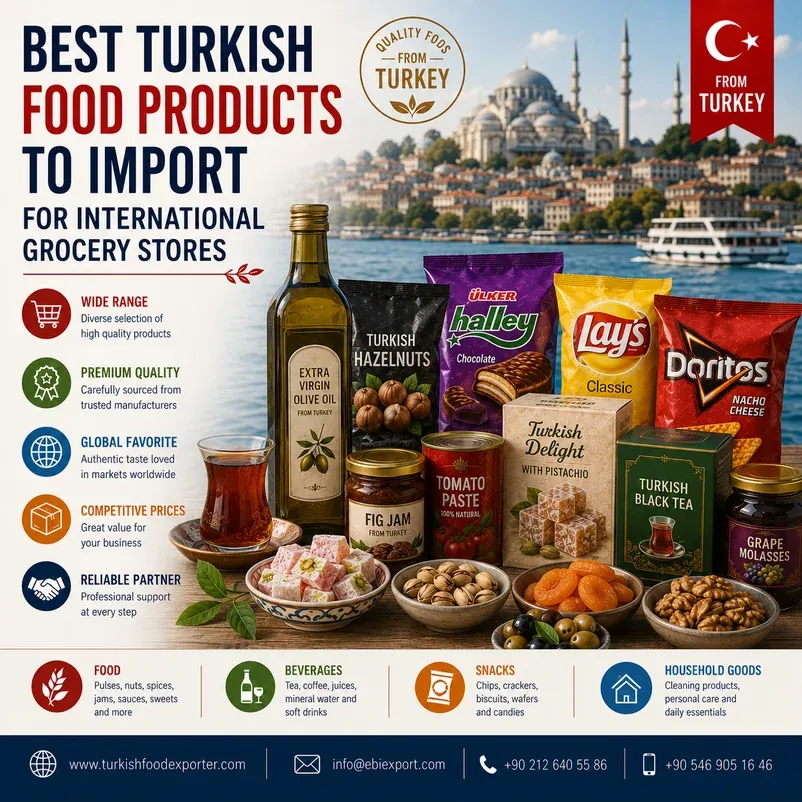
 Best Turkish Food Products to Import for International Grocery Stores
International grocery stores need products that can earn their place on the shelf. A good product should be easy to understand, simple to display, suitable for repeat purchase and strong enough to create customer curiosity. This is one reason why many grocery buyers look at Turkey as a serious sourcing market. Turkish food products combine familiar daily-use categories with traditional flavors, branded snacks, beverages, sauces and retail-ready FMCG items.
For store owners, wholesalers and importers, the question is not only “What can I buy from Turkey?” The better question is “Which Turkish products can sell well in my market?” A balanced import list should include products customers already know, products that create cultural value and products that bring something different to the grocery aisle. Turkish Food Exporter, as an Ebi Export brand, helps international buyers evaluate these categories and build a practical product mix for retail and wholesale supply.
A product may be popular in Turkey, but that does not automatically mean it is the right product for every international grocery store. Buyers should look at shelf life, packaging size, brand awareness, taste profile, price level and how easily the product can be explained to customers. Grocery shelves are honest places; weak products do not hide for long.
The strongest Turkish import products usually fall into three groups. The first group includes everyday grocery items such as pasta, tomato paste, sauces, tea and coffee. The second group includes impulse products such as chips, biscuits, wafers, chocolate and candy. The third group includes traditional Turkish products such as Turkish delight, halva, jam and molasses-based items. A smart import plan uses all three groups instead of depending on only one category.
Staple food is one of the safest starting points for many grocery importers. These are products people use regularly in kitchens, restaurants and family meals. Turkish pasta, sauces, spices, soup mixes, ready meals and tomato paste can create steady movement because they are practical and easy to position.
For example, Turkish pasta products can fit both ethnic grocery stores and general food retailers. Pasta is familiar in almost every market, so buyers do not need to educate customers from zero. It can be sold with sauces, tomato paste and spices to create a stronger shelf group.
Turkish tomato paste is another important category. It is used in home cooking, restaurants and traditional recipes, and it can appeal to customers from Turkish, Middle Eastern, Balkan, Mediterranean and Central Asian backgrounds. For importers, tomato paste also has a clear commercial advantage: it is a repeat-use kitchen product, not a one-time curiosity.
Snack products can give international grocery stores energy. Chips, crackers, biscuits, wafers, chocolate, cakes, gum and candy are easy to display and easy for customers to try. They also work well near checkout areas, snack aisles and promotional sections.
The Turkish chips category is especially useful for importers who want recognizable branded products and quick consumer interest. Products such as potato chips, corn snacks and flavored crisps can attract both ethnic customers and wider retail audiences. Snack buyers often like variety, so different flavors and package sizes can help stores test demand without depending on a single item.
Biscuits, crackers and wafers are also strong choices. These products usually have broad appeal and can be sold as family snacks, tea-time products or lunchbox items. For international grocery stores, Turkish biscuits and wafers can help create a more complete snack section alongside chips and confectionery.
Traditional products give Turkish grocery imports their identity. Turkish delight, halva, jam, molasses paste and dessert products are not just food items; they carry memory, culture and gift value. This makes them attractive for ethnic markets, specialty stores and international retailers that want a distinctive product range.
Turkish delight is one of the most recognizable Turkish products abroad. It can be sold as a sweet snack, a gift item or a traditional dessert. For grocery stores, it works best when offered with clear packaging, attractive flavor options and proper shelf placement.
Halva and jam products can also perform well, especially in markets where breakfast spreads, sesame-based sweets and traditional desserts are already known. These products may not always move as fast as chips or beverages, but they strengthen the Turkish product identity of a store.
Beverages can complete an import product range beautifully. A store that sells Turkish snacks, pasta and sweets can create a stronger shopping experience by adding drinks. Turkish bottled water, soda, lemonade, iced tea and fruit juice products can support both daily consumption and promotional sales.
The fruit juice category includes products suitable for families, lunchboxes, grocery shelves and convenience stores. Importers can consider different package sizes, from small single-serve options to larger bottles for home use.
Iced tea and soft drinks are also worth attention. Products such as lemon tea, peach tea, mango-pineapple flavors, soda and carbonated drinks can help grocery stores offer more variety in the beverage aisle. In many markets, beverages are also useful for mixed shipments because they support basket value.
Tea and coffee are powerful categories because they are part of daily habits. Turkish black tea, herbal tea, instant coffee and coffee mixes can appeal to ethnic customers as well as consumers looking for new flavors. For grocery stores, these products are compact, shelf-friendly and easy to group with sweets, biscuits and breakfast items.
Turkish tea products are especially important for stores serving Turkish and regional communities. Tea is not a decorative category; it is a habit. When a grocery store carries the right tea products, customers often return for them regularly.
Coffee products can also add value, especially instant coffee, stick coffee and retail-size packages. These products are practical for offices, homes and small markets. Importers can include tea and coffee as part of a wider Turkish grocery selection.
Although food is the main focus, many international grocery stores also carry household and personal care products. This is where Turkish FMCG sourcing can become broader. Shampoo, soap, cologne, detergent, softener and dishwashing products can help importers increase product variety without moving away from retail demand.
For example, shampoo products from Turkey can be included in mixed FMCG orders for stores that sell more than food. Cleaning products may also be useful for distributors supplying small markets, supermarkets and neighborhood retailers.
The best Turkish food products to import will depend on the target country and customer profile. A store serving a Turkish community may prioritize tea, coffee, tomato paste, Turkish delight, halva and traditional grocery products. A larger international grocery store may prefer snacks, beverages, pasta, sauces and branded FMCG items. A distributor may need a wider mix that can serve many different retailers.
A practical first order should usually include both fast-moving and identity-building products. Snacks, beverages and pasta can support quick sales. Turkish delight, tea, halva and tomato paste can strengthen the store’s Turkish product section. This balance helps buyers test the market while still presenting a serious product range.
Turkish Food Exporter helps importers and wholesalers source different Turkish food and FMCG categories through an export-focused supply approach. For international grocery stores, the goal should be simple: choose products that customers understand, trust and buy again.
Turkey offers the variety needed for that goal. With the right product selection and a reliable export partner, grocery stores can build a strong Turkish shelf that serves daily needs, cultural tastes and new customer curiosity at the same time.