
EBİ EXPORT is a foreign trade company that provides services to hypermarkets, fast moving consumer goods suppliers, ethnic markets and wholesalers. We are exporting to more than 20 different countries.
EBİ EXPORT is a foreign trade company that provides services to hypermarkets, fast moving consumer goods suppliers, ethnic markets and wholesalers. We are exporting to more than 20 different countries.
It is an Ebi Export Brand
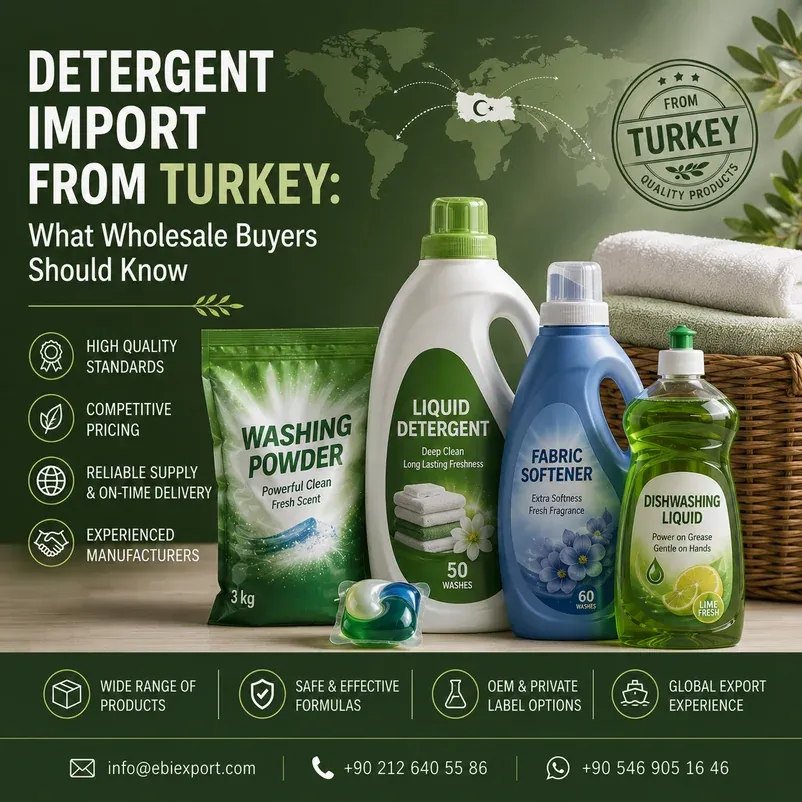
 Detergent Import from Turkey: What Wholesale Buyers Should Know
Detergent import from Turkey can be a strong opportunity for wholesale buyers that want practical household products with repeat-purchase potential. Detergent is not a product people buy once out of curiosity. It belongs to regular home care, laundry routines, cleaning habits and everyday household needs. For importers, distributors, supermarkets, ethnic markets and general FMCG wholesalers, this makes detergent an important category to evaluate carefully.
Turkey offers a wide FMCG supply structure that includes food, beverages, personal care products and household cleaning goods. For buyers already sourcing Turkish grocery products, detergent can be a useful category extension. Turkish Food Exporter, as an Ebi Export brand, helps international buyers review detergent and related cleaning products from Turkey with a practical wholesale perspective.
Detergent may look ordinary on the shelf, but commercially it carries weight. Customers use it regularly, households need it constantly and retailers understand how to sell it. This gives detergent products an advantage over many slower-moving imported items. A buyer does not need to create demand from zero; the demand already exists. The real question is whether the product, price and packaging fit the destination market.
For wholesale buyers, detergent can serve supermarkets, small markets, neighborhood shops, hotels, laundries, household goods stores and regional distributors. This broad channel fit makes the category useful for importers who want products that can move through more than one sales route. A distributor that can sell detergent to many types of retailers has more room to build repeat orders.
The Turkish laundry products category can be reviewed by buyers looking for detergent and related household cleaning items from Turkey. Detergent can also be combined with softener, bleach, dishwashing products, shampoo, soap and other FMCG goods to create a wider supply plan.
Detergent products can come in different formats, and each format serves a different customer need. Powder detergent may be suitable for price-sensitive markets, family use and high-volume household cleaning. Liquid detergent may appeal to customers looking for convenience, easy dosing and modern laundry habits. Concentrated formulas may be useful in markets where smaller packaging and efficiency matter.
Wholesale buyers should not choose a format only by personal preference. The target customer should decide the product direction. Some markets still prefer large powder detergent packages because customers associate them with value. Other markets may prefer liquid detergents because they are easier to use and store. Some retailers may need smaller packs for frequent purchases, while supermarkets may prefer larger family-size options.
The first import order should usually include a controlled selection. Instead of buying too many formats at once, importers can choose one or two detergent types, several package sizes and related laundry products. This makes market feedback easier to read. A first shipment should teach the buyer something useful, not create a warehouse full of unanswered questions.
Packaging size is one of the most important decisions in detergent import. Large packages can look attractive because they may offer better unit value, but they also require more shelf space, stronger cartons and higher upfront purchase decisions from customers. Smaller packages may move faster in neighborhood stores, price-sensitive markets or channels where customers shop more frequently.
Importers should think about how customers carry, store and use detergent. A large family may prefer bigger packs. A single-person household may choose smaller sizes. A hotel or laundry service may need bulk formats. A small retailer may want packages that fit limited shelves. The right packaging is not the one that looks impressive in the catalog; it is the one that fits real customer behavior.
Retail positioning should also be clear. Is the detergent a value product, a family product, a concentrated product, a fragrance-focused product or a premium cleaning option? If the package does not communicate its role quickly, the customer may pass it by. Household cleaning shelves are practical places; they reward clarity.
Detergent becomes stronger when it is sold with related cleaning products. Fabric softener can support laundry care through fragrance and fabric feel. Bleach can serve hygiene and deep-cleaning needs. Dishwashing and surface-cleaning products can complete the household section. For wholesale buyers, this creates a better category offer for retailers.
A retailer may hesitate to buy only one detergent product from a new importer. But a planned cleaning range with detergent, softener, bleach and other household items can feel more useful. This is especially true for small markets and supermarkets that need complete shelf groups rather than isolated products.
Buyers can also review other cleaning items from Turkey when building a broader FMCG product list. A complete cleaning section gives distributors more selling power and helps stores serve everyday household demand more effectively.
Before importing detergent from Turkey, buyers should request detailed product information. Important details include product format, package size, units per carton, carton dimensions, gross weight, net weight, pallet structure, barcode, ingredients, fragrance options, storage conditions, available stock and shipment timing.
These details are not paperwork decoration. They affect landed cost, warehouse planning, retail listing and final shelf price. Detergent can be heavy, bulky or sensitive to leakage depending on the format. A weak carton or unstable bottle can create damage during shipment. A small packaging mistake can become an expensive problem when multiplied across pallets.
Buyers should also ask about product continuity. If a detergent product performs well in the destination market, can it be supplied again? Are package sizes stable? Are formulas and labels consistent? Retailers do not like disappearing products, especially in household categories where customers return for the same item.
Cleaning products may have different import rules from food products. Detergents can require ingredient declarations, usage instructions, warning labels, safety information, local language labels, importer details or chemical compliance documentation depending on the destination country. Wholesale buyers should check these requirements before confirming an order.
The exporter can provide product and export-side information, but importers should confirm local regulations with customs brokers, compliance consultants or official authorities in their own market. This step is not optional decoration. It is the difference between a clean shipment and a shipment that waits at customs with an expensive expression on its face.
Buyers should pay special attention to liquid detergents and chemical household products. Packaging, labeling and transport requirements may vary by market. If the importer is unsure, it is better to clarify early than to solve the problem after the goods arrive.
Detergent import requires careful logistics calculation. Powder detergent can be heavy. Liquid detergent needs secure packaging. Large packages take shelf and container space. Carton structure, pallet strength and loading plan should be reviewed before shipment. The goal is to protect product quality and control final cost.
Importers should calculate landed cost carefully. Product price is only one part of the real number. Freight, customs, local transport, warehouse handling, retailer margin and possible compliance costs all affect the final shelf price. A detergent product must compete with local and imported alternatives, so pricing should be realistic from the beginning.
If detergent is included in a mixed FMCG order, loading should be planned with care. Heavy cleaning products can be shipped with lighter products such as snacks, biscuits, wafers, personal care items or dry grocery goods. This can make the shipment more balanced, but only if the exporter organizes the loading properly.
Different buyers need different detergent strategies. Supermarkets may need strong packaging, clear labels and several package sizes. Small markets may prefer affordable products with simple benefits. Hotels and laundries may focus on performance and bulk supply. Ethnic grocery stores may add detergent as part of a wider Turkish household goods section.
For importers serving ethnic markets, detergent can be sold beside Turkish soap, cologne, shampoo, food products and beverages. Customers who shop for Turkish grocery products may also buy household items during the same visit. This gives retailers a chance to increase basket value with everyday-use products.
For general wholesale distribution, the product must be competitive on price, performance and packaging. Buyers should compare detergent from Turkey with local alternatives in the destination market. If the product cannot compete directly, it must offer another clear advantage such as fragrance, package value, Turkish brand identity or category pairing.
Detergent can be part of a wider Turkish FMCG supply plan. Importers may combine detergent with Turkish shampoo products, soap, cologne, softener, dishwashing products and household cleaning items. This creates a stronger non-food offer for retailers.
A distributor can also combine cleaning products with food and beverage categories. Turkish snacks, fruit juice, tea, coffee, pasta, tomato paste and detergent may seem different at first, but many small retailers sell all of them. What matters is the buyer’s customer network. If retailers need both grocery and household products, a mixed FMCG shipment can make commercial sense.
Turkish Food Exporter helps international buyers evaluate detergent not as a lonely product, but as part of a practical product range from Turkey. This wider view can help wholesalers build stronger offers for supermarkets, ethnic markets and regional retail customers.
A first detergent order should be planned with discipline. Buyers can begin with one or two product formats, several package sizes and related cleaning products such as softener or bleach. After the products reach the market, sales performance should guide future orders.
Importers should track which package size moved fastest, which fragrance customers preferred, which stores reordered and whether the final shelf price was competitive. Retail feedback is more valuable than assumptions. The market may be quiet, but it always answers through reorder behavior.
For wholesale buyers, detergent import from Turkey can become a strong category when product selection, compliance, packaging and logistics are handled correctly. With a reliable export partner, buyers can build a cleaning products range that supports everyday household demand and strengthens a broader FMCG portfolio.
Turkish Food Exporter supports international buyers looking for detergent, cleaning products and household FMCG goods from Turkey. Buyers can evaluate detergent together with softener, bleach, dishwashing products, shampoo, soap, cologne and other retail categories.
For importers, the best detergent strategy is built on clear product details, practical packaging, local compliance checks and realistic landed cost. Detergent is a simple product for customers, but it requires serious planning for wholesale trade.
With the right approach, detergent import from Turkey can help wholesalers serve supermarkets, household goods stores, ethnic markets and regional distributors with a category that customers need again and again.