
EBİ EXPORT is a foreign trade company that provides services to hypermarkets, fast moving consumer goods suppliers, ethnic markets and wholesalers. We are exporting to more than 20 different countries.
EBİ EXPORT is a foreign trade company that provides services to hypermarkets, fast moving consumer goods suppliers, ethnic markets and wholesalers. We are exporting to more than 20 different countries.
It is an Ebi Export Brand
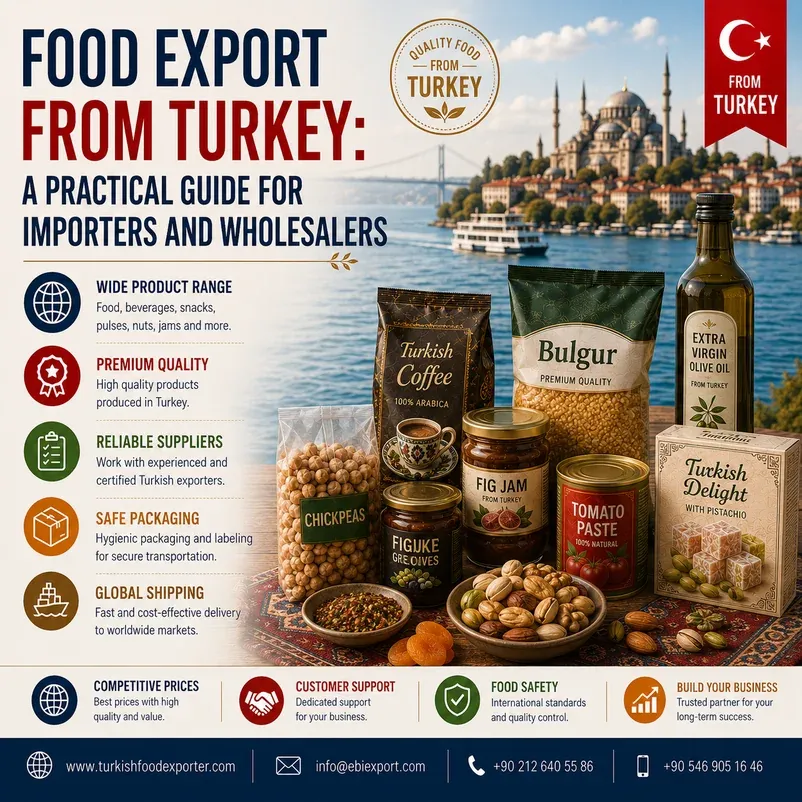
 Food Export from Turkey: A Practical Guide for Importers and Wholesalers
Food export from Turkey has become an important sourcing option for importers, wholesalers, supermarket chains and ethnic grocery distributors around the world. Turkey offers a wide range of food and FMCG products, from staple foods and sauces to snacks, beverages, tea, coffee, confectionery and household products. For buyers, the real advantage is not only product variety, but also the ability to build a flexible supply structure from one country with strong production and export experience.
For an importer, choosing the right product is only the first part of the process. The bigger question is how to source products safely, how to compare suppliers, how to plan quantities, and how to manage export details without losing time. A professional export partner can make this process much smoother. Turkish Food Exporter, as an Ebi Export brand, supports international buyers who want to access reliable Turkish food products for retail and wholesale markets.
Turkey has a strong position in food production because it combines agricultural richness, established manufacturing capacity and developed logistics connections. Many Turkish products are already familiar in international markets, especially in Europe, the Middle East, Central Asia, Africa and North America. This creates a practical advantage for importers who want products with both cultural value and commercial shelf potential.
The country’s product range is broad. Buyers can source pasta, tomato paste, sauces, spices, soup mixes, snacks, confectionery, beverages, tea, coffee, Turkish delight, halva, jams and many other grocery products. This makes food export from Turkey suitable not only for traditional food importers, but also for FMCG distributors that want to create mixed product portfolios.
Another reason buyers choose Turkey is speed and flexibility. Many markets need regular supply, mixed orders and practical communication. When an exporter understands international trade, importers can move faster from product selection to shipment planning. In wholesale business, that speed is valuable, but it must always be supported by accuracy.
Food products from Turkey can serve different buyer profiles. Supermarkets may look for branded products that can be placed directly on retail shelves. Ethnic markets may focus on traditional Turkish products that appeal to local communities. Wholesalers may need high-volume products with stable pricing and repeat availability. Distributors may want a wider mix of food, beverages and household goods.
This is why importers should not look at Turkish food sourcing as a single-product operation. A buyer may start with tomato paste or snacks, then later add beverages, tea, coffee, Turkish delight or cleaning products. The strongest sourcing strategy usually begins with a clear market need and then expands with related categories.
Turkish Food Exporter works with this wider sourcing logic. Instead of limiting the process to one narrow product group, it helps buyers evaluate different FMCG categories from Turkey and build a more complete purchasing plan.
One of the most practical categories for importers is staple food. Products such as pasta, sauces, spices, soup mixes, ready meals and tomato paste are used frequently in daily cooking and can be suitable for many markets. These products are especially useful for grocery stores, regional wholesalers and food service suppliers.
Snack products are another strong area. Chips, biscuits, crackers, wafers, cakes, chocolate, gum and candy can move quickly in retail environments. Importers who want to test Turkish FMCG products often start with snacks because they are easy to display, familiar to consumers and suitable for mixed orders.
Beverages also carry strong potential. Turkey offers bottled water, soda, soft drinks, iced tea and fruit juice products in different package sizes. For markets where Turkish grocery products already have demand, beverages can support a stronger retail shelf presence.
Traditional products such as Turkish delight, halva, jam, molasses products and desserts are valuable for ethnic markets and specialty food stores. These products create a cultural connection and can also attract buyers looking for authentic Turkish flavors. When positioned correctly, they can become steady repeat products rather than seasonal items only.
The first step is defining the target market. Before asking for prices, importers should know where the products will be sold, who the buyers are and which product categories are most likely to move. A supermarket chain, an ethnic grocery distributor and a wholesale trader may all need food products from Turkey, but their priorities are different.
The second step is preparing a clear product request. Instead of asking for a general catalog only, buyers should define categories, preferred brands, package sizes, quantity expectations and destination country. For example, a request such as “snacks, tomato paste and beverages for wholesale distribution in Germany” gives the exporter a much clearer direction than a vague product inquiry.
The third step is checking product details. Importers should review carton quantity, shelf life, barcode, label language, pallet structure, minimum order quantity and availability. These details affect pricing, storage, shipment planning and customs procedures. In food export, small details are not small; they are the screws holding the machine together.
The fourth step is confirming logistics and documentation. Depending on the order size, products can be shipped as full container loads, mixed containers or other suitable export structures. A reliable exporter should guide the buyer about preparation, timing and shipment coordination.
Importers should ask whether products are currently available, whether the packaging is suitable for their market, and whether the exporter can provide updated product information. They should also check product origin, shelf life, carton details and shipment readiness. These questions may sound basic, but they prevent many expensive misunderstandings.
Buyers should also ask about mixed product supply. Many wholesalers prefer to combine different categories in one shipment. For example, one order may include chips and snack products, pasta, tomato paste, beverages and Turkish delight. If the exporter can manage this structure professionally, the buyer saves time and reduces operational complexity.
Another important question is communication speed. International trade requires quick answers and clear information. When a buyer needs product details, quotation updates or shipment information, delays can affect the whole purchasing plan. A good exporter does not disappear after sending a catalog. That sounds obvious, but in trade, obvious things are often where the trouble begins.
Wholesalers often serve many different retailers, so they need variety. A single category may not be enough to fill market demand. Mixed FMCG orders allow wholesalers to build a wider product offer with snacks, beverages, staple foods, confectionery and household products. This gives them more flexibility when selling to grocery stores, supermarkets and local distributors.
Mixed orders are also useful for market testing. An importer may not know which Turkish products will sell fastest in the beginning. By testing different categories, the buyer can understand consumer demand before placing larger repeat orders. This is a more careful and intelligent way to grow, especially in competitive retail markets.
Turkish Food Exporter supports this approach by offering access to different product categories from Turkey. Buyers can start with a focused list and then expand according to real sales performance in their own market.
The right export partner should understand both the Turkish supply side and the buyer’s market expectations. Product sourcing is not only about finding goods; it is about preparing the right goods for the right market at the right time. Importers should work with companies that can communicate clearly, provide realistic information and support long-term cooperation.
A good Turkish food exporter should be able to explain product alternatives, help compare categories and support the buyer with export preparation. This is especially important for companies that are importing from Turkey for the first time. The process becomes easier when the exporter knows how wholesalers and retailers actually work.
Turkish Food Exporter helps importers and wholesalers source Turkish food and FMCG products with a broad product portfolio. From staple foods and snacks to beverages, personal care and cleaning products, buyers can evaluate different product groups through a professional export-focused structure.
The best results in import business usually come from long-term supply relationships. A single order may test the market, but repeat orders build stability. Importers should track which products sell quickly, which package sizes perform better and which categories create stronger margins. After that, the product list can be improved step by step.
Food export from Turkey gives international buyers a strong starting point because the product range is wide and adaptable. With the right sourcing strategy, wholesalers can serve different retail channels and build a reliable supply line from Turkey.
For importers looking for Turkish food products, the practical path is clear: define the market, select the right categories, check product details, plan logistics carefully and work with an exporter that understands the full process. Turkish Food Exporter brings these pieces together for buyers who want reliable food and FMCG supply from Turkey.