
EBİ EXPORT is a foreign trade company that provides services to hypermarkets, fast moving consumer goods suppliers, ethnic markets and wholesalers. We are exporting to more than 20 different countries.
EBİ EXPORT is a foreign trade company that provides services to hypermarkets, fast moving consumer goods suppliers, ethnic markets and wholesalers. We are exporting to more than 20 different countries.
It is an Ebi Export Brand
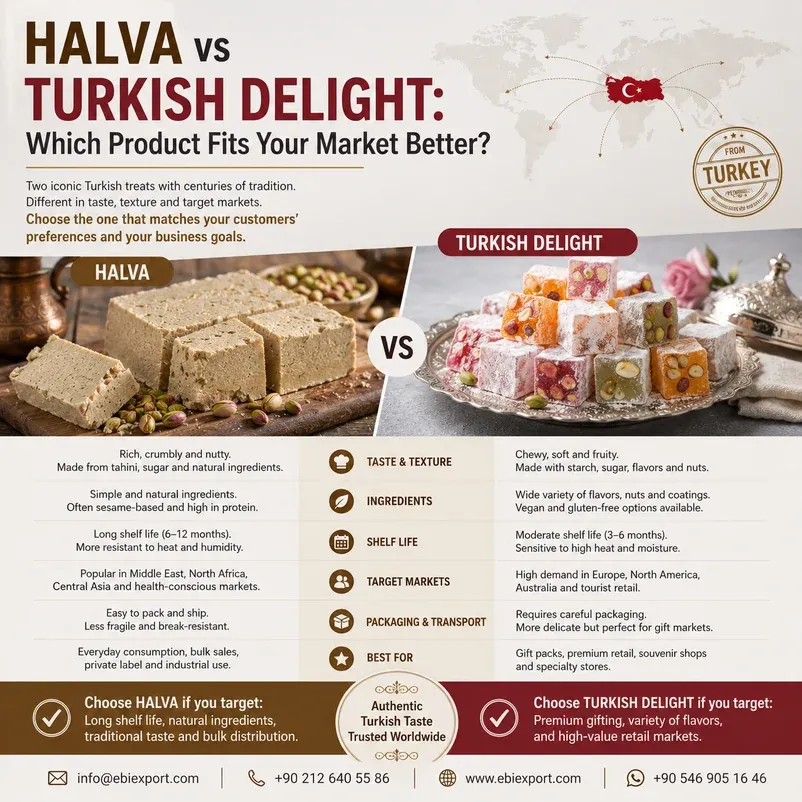
 Halva vs Turkish Delight: Which Product Fits Your Market Better?
Halva and Turkish delight are two of Turkey’s most recognizable sweet products, but they do not play the same role in every market. For importers, wholesalers, ethnic grocery stores, supermarkets and specialty food buyers, choosing between them is not only a matter of taste. It is a commercial decision shaped by customer habits, packaging, shelf placement, price level, cultural familiarity and repeat-purchase potential.
Turkish delight often attracts attention because it is internationally known as a traditional sweet from Turkey. Halva, on the other hand, can create stronger everyday value in markets where sesame-based sweets, breakfast products and tea-time foods are already familiar. Turkish Food Exporter, as an Ebi Export brand, helps international buyers evaluate both Turkish halva and Turkish delight products according to market fit, packaging and wholesale supply needs.
Halva and Turkish delight belong to the same broad world of Turkish sweets, but they are very different products. Halva is usually denser, richer and often connected with sesame, tahini-style flavor and traditional dessert habits. It can be eaten after meals, with tea, at breakfast, during special occasions or as a filling sweet snack. Its texture and taste are deep, earthy and satisfying.
Turkish delight is softer, lighter and more confectionery-focused. It is usually cut into cubes and may include flavors such as rose, lemon, orange, pomegranate, pistachio, hazelnut or mixed fruit depending on the product. It is often positioned as a gift product, tea-time sweet, traditional candy or specialty imported confectionery. It has a more decorative shelf personality than halva.
For buyers, this difference matters. Halva may fit markets where customers already enjoy rich, traditional sweets. Turkish delight may perform better where visual appeal, gifting and curiosity are stronger sales drivers. One product speaks to habit; the other often speaks first to discovery.
Halva can be a strong choice for markets with customers who already know sesame-based sweets, tahini products, Middle Eastern desserts, Balkan foods or traditional Turkish grocery items. In these markets, halva does not need much explanation. Customers understand the taste direction and know when to eat it. That makes selling easier for ethnic grocery stores and regional food distributors.
Halva can also work well as a repeat-purchase product. A customer who enjoys halva may buy it regularly for home use, guests, tea-time or dessert after meals. This gives importers a different kind of value than a one-time gift sweet. A product that becomes part of a household routine can support steadier wholesale demand.
Retailers can place halva near tea, coffee, tahini, molasses, jam, breakfast products or traditional sweets. It should not be treated only as candy. In many markets, halva performs better when it is presented as a traditional food product with everyday and family use. That shelf story can make the product easier to understand.
Turkish delight is often the better choice when buyers want a product with strong visual charm and international recognition. Many customers have heard the name before, even if they do not know every flavor or style. This gives Turkish delight a useful opening in supermarkets, specialty food shops, gift stores, online grocery platforms and ethnic markets.
Turkish delight can perform well during holidays, gift seasons, family visits, festive periods and tea-time promotions. Gift boxes, assorted flavors and nut-filled varieties can create a more premium impression. For importers, this means Turkish delight can serve both everyday retail and seasonal sales if the packaging is chosen correctly.
In markets where Turkish food culture is not deeply known, Turkish delight may be easier to introduce than halva because it has a clearer international image. Customers may be curious about it as an authentic Turkish sweet. However, curiosity alone is not enough. The product still needs good packaging, clear flavor information and suitable pricing.
Halva is usually stronger as a traditional grocery and dessert product. Turkish delight is usually stronger as confectionery, gift and specialty sweet. This does not mean one is better than the other. It means each product needs its own place on the shelf.
For ethnic markets, both products can work together. Halva may serve loyal customers looking for familiar foods, while Turkish delight may attract both regular customers and gift buyers. For supermarkets, Turkish delight may be easier to display in confectionery or international food sections, while halva may need clearer explanation if customers are less familiar with the product.
For wholesalers, the best decision depends on retailer type. If the distributor serves Turkish, Middle Eastern, Balkan or Mediterranean grocery stores, halva and Turkish delight can both be important. If the distributor serves general supermarkets, Turkish delight may be a safer first product, while halva can be added once the Turkish sweets category gains traction.
Packaging can change the performance of both products. Halva may be offered in blocks, sliced packs, smaller retail portions or family-size packaging depending on availability. Its packaging should protect texture and freshness. It should also make the product look clean, rich and easy to serve.
Turkish delight packaging often has more visual variety. Transparent boxes, gift boxes, assorted packs and premium presentations can all serve different channels. A specialty store may prefer elegant gift packaging. A supermarket may prefer smaller retail packs. An ethnic market may prefer familiar traditional boxes or larger family-style options.
Importers should check package weight, units per carton, carton dimensions, shelf life, barcode, ingredient information and storage conditions before ordering. Sweet products may look gentle, but logistics can be blunt. A crushed box, sticky product or damaged label can weaken sales before the customer even tastes anything.
Halva variety is often built around texture, base ingredient and flavor additions. Plain halva, cocoa halva, pistachio halva or nut-based options may appeal to different customer groups depending on availability. Buyers should avoid assuming that the most unusual option is automatically the best. In traditional products, familiar flavors often move faster.
Turkish delight offers wider flavor variety. Rose, lemon, orange, pomegranate, pistachio, hazelnut, walnut, coconut-covered and assorted options can all serve different shelf needs. This variety is attractive, but it must be controlled. Too many flavors in a first order can make stock harder to manage and sales results harder to understand.
A practical first order may include one or two halva formats and several Turkish delight products, including classic assorted and one premium nut-filled option. This gives the importer enough range to test customer behavior without flooding the shelf.
Repeat sales depend on the market. In communities where halva is already known, halva can create strong repeat demand because customers buy it for home use. It may become a pantry product rather than only a special treat. That makes it valuable for ethnic grocery stores and traditional food retailers.
Turkish delight can also create repeat demand, especially in stores with loyal Turkish or regional customers. However, in broader markets, it may behave more like a gift or occasional sweet. This can still be profitable, but the buyer should understand the rhythm. A product that sells strongly during festive periods may not move at the same speed every month.
The safest approach is to track sales by package type and season. If Turkish delight gift boxes sell well during holidays, stock planning should follow that rhythm. If halva sells steadily throughout the year, it may deserve more regular reorder planning.
Both products become stronger when they are sold with related Turkish grocery items. Tea and coffee are natural companions. A customer buying sweets may also buy Turkish tea products or coffee products. This makes shelf pairing important for retailers.
Halva can also be placed near jam, molasses, breakfast items and pantry products. Turkish delight can sit near biscuits, wafers, chocolate, gift products and tea-time sections. Importers can also add biscuits and crackers to build a wider sweet and snack range.
When products are grouped with purpose, customers understand them faster. A Turkish sweets shelf with tea, coffee, halva, Turkish delight, biscuits and jam feels complete. A shelf with one lonely box of sweets feels like an afterthought.
Wholesale buyers should plan halva and Turkish delight orders according to sales channels. Ethnic grocery stores may need larger quantities of familiar products. Supermarkets may need smaller packs with clear labeling. Specialty stores may prefer premium gift boxes. Online sellers may need attractive packaging and strong product descriptions.
Before ordering, buyers should request full product details. Important points include product name, flavor, package weight, units per carton, gross weight, shelf life, production date, expiry date, barcode, ingredient list, allergen information and storage requirements. Nut-filled sweets require special attention because allergens must be declared clearly in many markets.
Importers should also think about stock rotation. Sweet products must arrive with enough shelf life for customs clearance, warehousing and retail distribution. Short-dated products can create discount pressure and retailer hesitation. In export, time is part of the product, even though it is not printed in large letters on the front of the box.
If the target market already knows Turkish and regional foods, halva can be a strong repeat product. It fits daily use, family consumption and traditional grocery shelves. If the target market is broader and less familiar with Turkish sweets, Turkish delight may be easier to introduce because it has stronger international recognition and gift appeal.
If the buyer serves ethnic markets, the best answer may be both. Halva can support loyal customers and regular purchases. Turkish delight can support gifts, tea-time sales and visual shelf attraction. If the buyer serves supermarkets, starting with Turkish delight and adding halva as the category grows may be a practical path.
The decision should not be made by taste alone. Importers should look at customer familiarity, package size, shelf placement, price level, seasonality and repeat demand. The right product is the one that fits the market’s habits, not the one that wins a debate in the office.
Turkish Food Exporter helps international buyers evaluate halva, Turkish delight, jam and other traditional sweet products from Turkey. Buyers can compare product types, packaging formats, flavors and wholesale order options according to their target market.
For importers and distributors, halva and Turkish delight can both bring value when positioned correctly. Halva offers depth, familiarity and regular use in the right markets. Turkish delight offers recognition, gift appeal and attractive confectionery presentation. Together, they can help retailers build a stronger Turkish sweets category.
With clear product information, careful packaging selection and reliable export planning, Turkish halva and Turkish delight can become useful products for ethnic markets, supermarkets, specialty stores and wholesale buyers. Turkish Food Exporter supports that process with a practical sourcing approach designed for international grocery and FMCG supply.