
EBİ EXPORT is a foreign trade company that provides services to hypermarkets, fast moving consumer goods suppliers, ethnic markets and wholesalers. We are exporting to more than 20 different countries.
EBİ EXPORT is a foreign trade company that provides services to hypermarkets, fast moving consumer goods suppliers, ethnic markets and wholesalers. We are exporting to more than 20 different countries.
It is an Ebi Export Brand
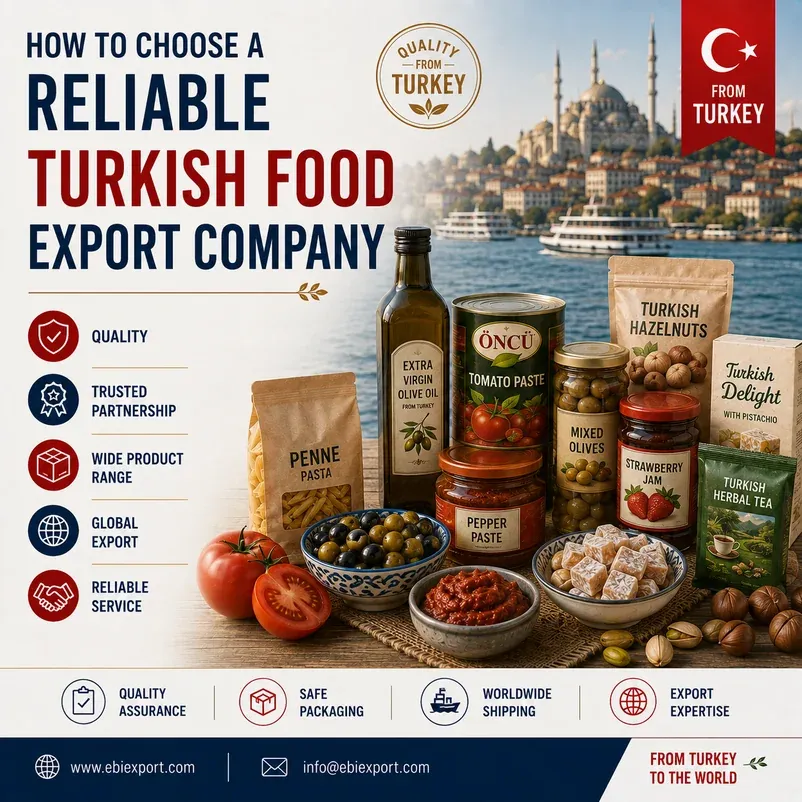
 How to Choose a Reliable Turkish Food Export Company
Choosing a reliable Turkish food export company is one of the most important decisions an importer can make when sourcing products from Turkey. The product itself matters, of course, but the company behind the product matters even more. A good exporter protects the buyer from confusion, delays, weak communication, wrong product expectations and shipment problems. A poor exporter, on the other hand, can turn a simple order into a long commercial headache.
Turkey has a wide product range for global food and FMCG markets. Importers can source staple foods, snacks, beverages, sweets, tea, coffee, personal care products and household goods from Turkish suppliers. This variety creates strong opportunities for supermarkets, ethnic markets, wholesalers and distributors. However, variety also makes supplier selection more serious. Buyers need an export partner that can manage products, documents, logistics and communication in a clear and professional way.
Turkish Food Exporter, as an Ebi Export brand, works with international buyers that want to source Turkish food and FMCG products for retail and wholesale markets. For buyers searching for a Turkish food export company, the goal should not be to find the fastest price list. The real goal should be to find a company that can build a reliable supply process from the first inquiry to repeat orders.
The first thing to check is the exporter’s product range. A reliable export company should offer categories that match your business model. If you are a supermarket buyer, you may need branded retail products with strong shelf appeal. If you are an ethnic grocery distributor, you may need traditional Turkish products such as tea, coffee, Turkish delight, halva, tomato paste and sauces. If you are a wholesaler, you may need fast-moving products with practical carton structures and stable availability.
A strong Turkish food exporter should be able to support more than one category. This is important because many buyers prefer mixed orders. Instead of importing only one item, they may want to combine pasta products, tomato paste, snacks, beverages, tea and confectionery in one supply plan. A company with a broader FMCG structure can help buyers build a more useful product portfolio.
The exporter should also understand category logic. Products should not be offered randomly. Pasta, sauces and tomato paste can form a cooking category. Tea, coffee, biscuits and sweets can support a breakfast or dessert section. Chips, soft drinks and fruit juices can work together as snack and beverage products. A reliable exporter thinks in terms of shelf strategy, not only product names.
Product photos can look attractive, but photos do not prove export capability. A company may show many items, yet still struggle with product details, packaging information, documentation or shipment coordination. Importers should look beyond the catalog and ask whether the company has real export experience with international buyers.
A reliable Turkish food export company should understand commercial details such as carton quantity, pallet structure, barcode information, shelf life, minimum order quantity, loading options and shipment timing. These details may seem technical, but they directly affect cost, customs preparation, warehouse planning and retail pricing.
Buyers should also pay attention to how the exporter answers questions. A serious company gives clear and realistic information. If every answer is vague, delayed or incomplete, that is a warning sign. Export business depends on trust, but trust should be supported by details. Beautiful promises are cheap; accurate product information is the real currency.
Before choosing an exporter, buyers should request complete product information. This includes product name, brand, package size, carton quantity, expiry date, storage conditions and origin details. If the products will be sold in supermarkets or grocery stores, label language and packaging style should also be reviewed.
For example, if your business wants to import Turkish tomato paste, you should check whether the product is available in tin, jar or other packaging formats. You should also review gram size, carton count and shelf life. If you are importing snack products, you should check flavor options, package sizes and carton structure. If you are importing beverages, weight and loading details become especially important.
Good exporters do not treat these questions as a burden. They understand that importers need accurate information before making decisions. A reliable exporter helps the buyer compare products clearly and avoid mistakes before the order is confirmed.
Communication is one of the clearest signs of reliability. International trade moves through questions, confirmations, updates and documents. If communication is slow or unclear before the order, it will probably become worse during shipment preparation. Buyers should take this seriously.
A reliable Turkish food export company should respond with useful information, not only short answers. If a buyer asks about product availability, the exporter should explain what is ready, what can be sourced, what quantities are realistic and what alternatives may be suitable. If a buyer asks for mixed products, the exporter should help shape the list instead of simply sending a large catalog and disappearing into the fog.
Good communication also means honesty. If a product is not available, the exporter should say so. If lead time is longer than expected, the buyer should know early. If a product is not suitable for a specific market, the exporter should explain the risk. In export, the truth told early is cheaper than the apology told late.
Many international buyers do not want to source only one product category. A distributor may need snacks, beverages, sauces, pasta, Turkish delight, tea, cleaning products and personal care items in the same commercial period. A hypermarket buyer may want a wider selection for different aisles. An ethnic market may want traditional Turkish foods along with familiar modern FMCG products.
This is why mixed supply capability is valuable. A company that can help buyers access different Turkish FMCG categories can reduce the need to contact many separate suppliers. It can also make the purchasing process more organized. Instead of managing scattered conversations, the importer can work through one export-focused channel.
Turkish Food Exporter offers access to different product groups such as staple foods, chips and snack products, beverages, traditional sweets, personal care and cleaning products. This kind of range can help buyers create a balanced order that fits their market.
Not every product is suitable for every country. A product that sells well in Germany may not be the first choice for the United States. A package size that works in ethnic markets may not work in large supermarket chains. A flavor that is familiar in Turkey may need stronger explanation in another country. Reliable exporters should understand these differences and help buyers think through them.
Importers should explain their market clearly. Who will buy the products? Will they be sold in supermarkets, small grocery stores, ethnic markets, wholesale warehouses or online shops? Is the buyer looking for premium products, affordable daily-use items or branded FMCG goods? The more precise the business model is, the better the exporter can recommend products.
For example, Turkish delight, halva and tea may be strong for ethnic and specialty markets. Chips, fruit juice, pasta and sauces may work well in broader grocery channels. Shampoo, soap and cleaning products may be useful for distributors that already supply FMCG retailers. The right exporter helps connect category choice with market reality.
Export is not complete when products are selected. Logistics and documentation must also be handled correctly. Buyers should ask how orders are prepared, how products are packed, what shipment options are available and which documents can be provided. Depending on the destination country, food products may require specific import checks, labels or certificates.
A reliable Turkish food export company should be able to discuss shipment planning in practical terms. Full container, mixed container, road transport, sea freight and other options may be considered according to order size and destination. The exporter should also provide realistic timelines. In international trade, unrealistic delivery promises are often the first crack in the wall.
Buyers should also work with their customs broker or local authorities to understand destination-country requirements. The Turkish exporter can support export preparation, but the importer must also confirm import rules in the target market. A strong supply process works best when both sides know their responsibilities.
Price is important, but it should not be the only decision factor. The lowest price may not be the best option if communication is weak, product details are unclear or shipment preparation is unreliable. Importers should compare the total value of the exporter: product range, accuracy, responsiveness, flexibility and ability to support repeat orders.
A reliable export company should help the buyer grow. The first order may be a test, but the real value comes from repeat business. After products reach the market, buyers can review which items sell faster, which categories need improvement and which products should be ordered again. A good exporter can support this process with alternatives and category suggestions.
This long-term view is especially important for wholesalers and distributors. Their customers expect continuity. If a product sells well but cannot be supplied again, the opportunity becomes weaker. Reliable exporters understand that repeat availability is part of the business, not an extra favor.
There are several warning signs buyers should not ignore. If an exporter cannot provide basic product details, that is a problem. If prices change without explanation, that is a problem. If communication becomes slower after the buyer shows serious interest, that is a problem. If the company avoids questions about packaging, shelf life or shipment structure, that is also a problem.
Buyers should also be careful with companies that promise everything too quickly. Export requires planning. A professional company may sometimes say “this product is not suitable,” “this quantity is not realistic,” or “this timeline may be difficult.” These answers may sound less exciting, but they are often signs of experience.
Turkish Food Exporter helps international buyers source food and FMCG products from Turkey through a practical export approach. The product range includes categories suitable for supermarkets, ethnic markets, wholesalers and distributors, such as staple foods, snacks, beverages, sweets, tea, coffee, personal care and household products.
For companies looking for a reliable Turkish food export company, the best choice is a partner that understands products, markets and export details together. A good exporter does not only send a list; it helps the buyer make sense of the list. It brings order to variety and turns product interest into a workable supply plan.
Turkey has strong potential for global food and FMCG buyers. With the right export partner, importers can access reliable products, build stronger retail shelves and create long-term supply opportunities. Turkish Food Exporter supports that process for businesses that want to source from Turkey with clarity, discipline and commercial focus.