
EBİ EXPORT is a foreign trade company that provides services to hypermarkets, fast moving consumer goods suppliers, ethnic markets and wholesalers. We are exporting to more than 20 different countries.
EBİ EXPORT is a foreign trade company that provides services to hypermarkets, fast moving consumer goods suppliers, ethnic markets and wholesalers. We are exporting to more than 20 different countries.
It is an Ebi Export Brand
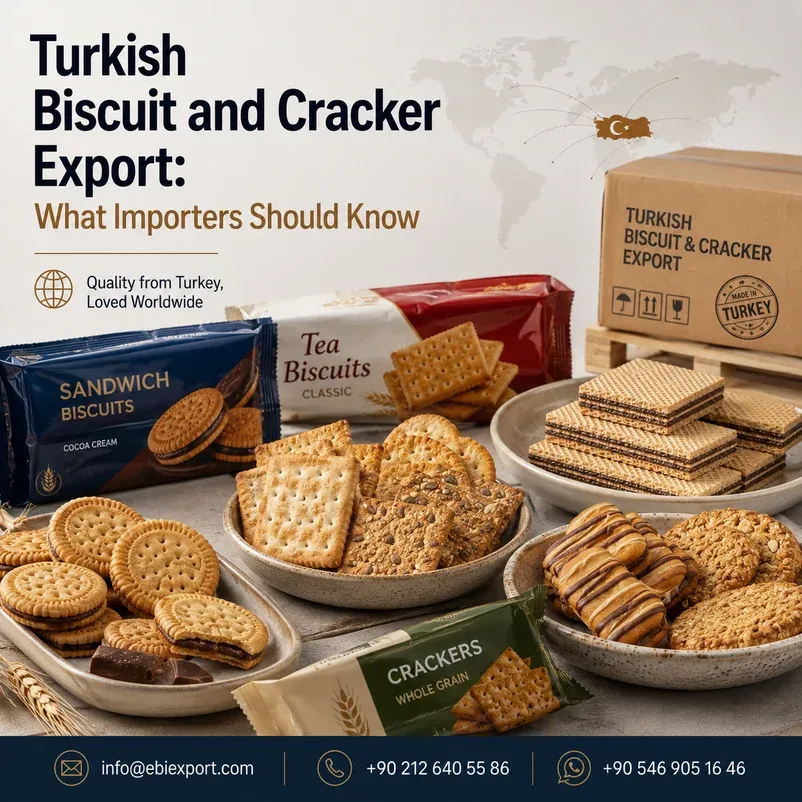
 Turkish Biscuit and Cracker Export: What Importers Should Know
Turkish biscuit and cracker export can be a strong opportunity for importers who want snack products with broad customer appeal, practical shelf life and repeat-purchase potential. Biscuits and crackers are familiar in many countries because they fit daily habits: tea-time, school snacks, lunchboxes, office breaks, family shopping and small treats. For supermarkets, ethnic markets, wholesalers, convenience stores and snack distributors, these products can support a wider Turkish FMCG range.
Unlike some specialty products that need a long explanation, biscuits and crackers are easy for customers to understand. The buyer’s real work is choosing the right product types, package sizes, flavors, price points and sales channels. Turkish Food Exporter, as an Ebi Export brand, helps international buyers evaluate Turkish biscuits, crackers and related snack categories for wholesale and retail supply from Turkey.
Biscuits and crackers are flexible products. They can be sweet or salty, simple or filled, family-oriented or single-serve, everyday or promotional. This flexibility makes them useful for importers who sell to different retail channels. A supermarket may need a broader shelf range, while a mini market may prefer fast-moving small packs. An ethnic store may want familiar Turkish snack brands, while a wholesaler may need products that can move across many stores.
The Turkish biscuit and cracker category can help buyers build a practical snack section. These products can stand beside chips, wafers, chocolate, cakes, candy and beverages. For retailers, they are easy to display and easy to connect with other categories.
Another advantage is repeat use. Customers may buy biscuits for children, guests, breakfast, tea or work breaks. Crackers may be used as salty snacks, lunch accompaniments or quick food items. A product that fits several daily moments has better chances of staying in the basket.
Sweet biscuits can serve family grocery stores, supermarkets, ethnic markets and convenience retailers. They may include plain biscuits, cream-filled biscuits, cocoa biscuits, milk biscuits, fruit-flavored biscuits or tea biscuits depending on availability. These products are easy to place because customers already know when and how to consume them.
For ethnic grocery stores, Turkish sweet biscuits can sit naturally near tea, coffee, wafers, cakes, Turkish delight and halva. For supermarkets, they can be placed in the biscuit aisle, snack section or family grocery shelf. For wholesalers, sweet biscuits can become a dependable category when the package size and price point fit the market.
Importers should build the first selection carefully. A balanced order may include several familiar sweet biscuit types and one or two more distinctive Turkish options. Too much variety at the beginning can make stock movement hard to read. A focused first order gives cleaner feedback.
Crackers are useful because they serve a different customer need from sweet biscuits. They can be eaten with tea, cheese, dips, soups, lunch items or as simple salty snacks. This makes them suitable for both grocery shelves and snack aisles. In some markets, crackers may also work well for office, school and travel consumption.
Cracker products from Turkey can help importers create a more balanced snack range. A shelf with only sweet items may miss customers looking for salty products. A shelf with chips only may feel too narrow. Crackers sit between snack and pantry, which gives them wider use.
Buyers should review flavor, texture, package size and carton quantity before ordering. Plain crackers may be easy to sell in many markets, while cheese, herb, spicy or seeded varieties may add interest. The best choice depends on customer habits in the destination country.
Biscuits and crackers become stronger when paired with tea and coffee. This is especially important for Turkish grocery products because tea-time culture is strong. A customer buying Turkish tea products may also buy biscuits, wafers or crackers. A customer buying coffee may add chocolate or sweet biscuits for guests.
For ethnic markets, this pairing is very natural. Turkish tea, coffee, biscuits, wafers, Turkish delight and halva can create a complete tea-time and hospitality section. Customers recognize the relationship between these products, so the shelf becomes easier to shop.
For supermarkets, biscuits and crackers can also be promoted with coffee, tea, fruit juice or lunch products. Retailers should not treat them only as isolated snacks. They are small products, but they can connect several buying occasions.
A strong snack portfolio should include several product types. Biscuits and crackers can be paired with Turkish chips products, wafers, cakes, chocolate, candy and gum. This gives importers a more complete snack offer for retailers.
Beverages can make the range even stronger. Fruit juice, iced tea, soda and bottled water all pair naturally with biscuits and crackers. A customer buying a snack may also buy a drink, especially in convenience stores and mini markets. Importers can use this behavior to build better wholesale offers.
The Turkish fruit juice category can support snack orders from Turkey. A distributor that sells biscuits, crackers and beverages together may become more useful to retailers than a supplier with only one category.
Packaging plays a major role in biscuit and cracker export. The package should protect the product from crushing, moisture and damage during transport. It should also communicate flavor, product type, portion size and brand identity clearly. Customers often decide quickly in snack aisles, so clarity matters.
Importers should review package weight, units per carton, carton dimensions, barcode, shelf life, ingredient list, allergen information, storage conditions and pallet structure before confirming an order. Biscuits and crackers may be lighter than beverages, but they can be fragile. A crushed biscuit is still edible sometimes, but it is not attractive retail stock.
Package size should match the sales channel. Single packs may work well for convenience stores, schools and quick snacks. Multipacks may be better for families and supermarkets. Larger wholesale formats may suit distributors or food service buyers. The right format depends on how the product will be sold.
Ethnic grocery stores may prefer Turkish biscuit products that customers already recognize or associate with home. These stores can sell biscuits and crackers beside tea, coffee, sweets and traditional grocery products. The category can support both emotional familiarity and daily consumption.
Supermarkets may need products with wider appeal, clear packaging and strong price positioning. Sweet biscuits, cream biscuits, crackers and family packs can all work if the product range is organized. Convenience stores may prefer smaller packs that customers can buy quickly with drinks.
Wholesalers should choose products that can serve several retailer types. A biscuit that sells only in one narrow channel may be useful, but a product that can move through supermarkets, ethnic stores and mini markets gives the distributor more flexibility.
Wholesale buyers should plan biscuit and cracker orders with a clear category structure. A first order may include sweet biscuits, plain crackers, flavored crackers, wafers and related beverages or tea products. This creates a balanced selection without making the stock list too complicated.
Buyers should track which products sell first, which package sizes receive repeat demand, whether customers prefer sweet or salty options, and whether retailers ask for more snack products after the first order. These results help shape stronger repeat shipments. The market does not always speak loudly, but reorder data is a clean language.
Importers should also ask about supply continuity. If a product performs well, it should be available again. Retailers do not want to introduce a biscuit or cracker product that disappears after customers begin asking for it.
Before importing Turkish biscuits and crackers, buyers should review destination-country food labeling rules. These products may require ingredient declarations, allergen information, nutrition facts, local language labels, origin details, importer information and barcode data depending on the market.
Allergen information is especially important because biscuits and crackers may contain wheat, gluten, milk, soy, nuts or other ingredients. Importers should confirm these details before shipment. The exporter can provide product information, but local compliance should be checked with customs brokers or official authorities.
Shelf life should also be reviewed carefully. Biscuits and crackers usually have practical storage advantages, but the products must arrive with enough time for customs clearance, distribution and retail sale. Short-dated stock can create pressure and weaken retailer confidence.
Turkish Food Exporter supports international buyers looking for Turkish biscuit and cracker export products. Buyers can evaluate biscuits, crackers, wafers, chips, chocolate, candy, beverages, tea, coffee and other Turkish FMCG categories through a practical export-focused supply approach.
For importers, biscuits and crackers can be strong products when selected with the right flavor mix, packaging format, shelf strategy and wholesale plan. They serve daily snacking, tea-time habits, family shopping and convenience retail. With reliable sourcing from Turkey, these products can become steady parts of international snack and grocery supply.