
EBİ EXPORT is a foreign trade company that provides services to hypermarkets, fast moving consumer goods suppliers, ethnic markets and wholesalers. We are exporting to more than 20 different countries.
EBİ EXPORT is a foreign trade company that provides services to hypermarkets, fast moving consumer goods suppliers, ethnic markets and wholesalers. We are exporting to more than 20 different countries.
It is an Ebi Export Brand
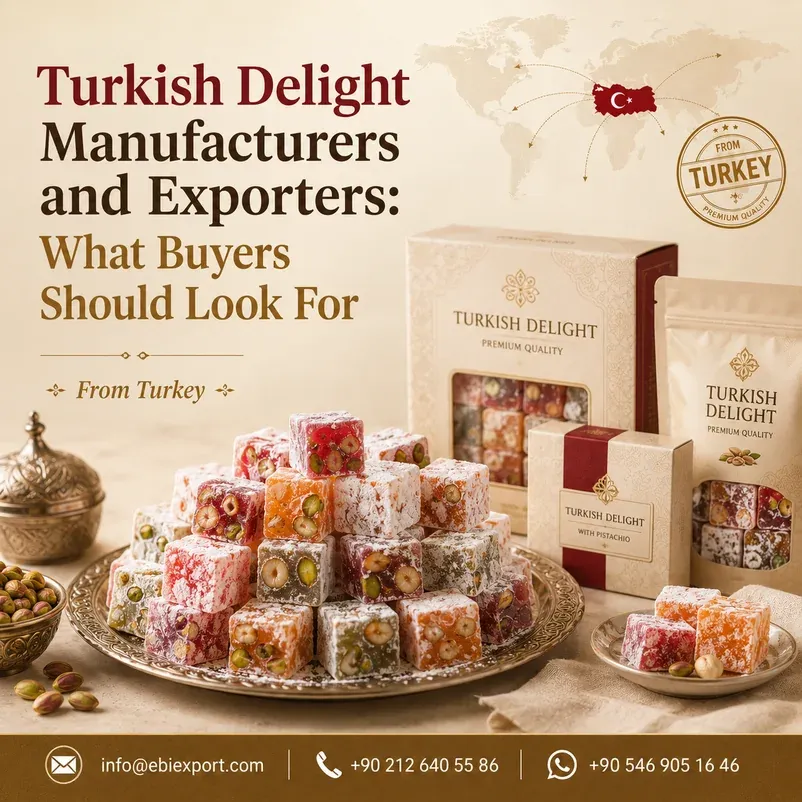
 Turkish Delight Manufacturers and Exporters: What Buyers Should Look For
Turkish delight manufacturers and exporters can offer strong opportunities for buyers who want a traditional sweet product with international recognition, gift appeal and retail shelf value. Turkish delight is one of the best-known confectionery products from Turkey, but choosing the right supplier requires more than selecting a colorful box from a catalog. Importers need to review product quality, flavor range, packaging, shelf life, labeling, order structure and export reliability before making a decision.
For supermarkets, ethnic grocery stores, wholesalers, specialty food shops and distributors, Turkish delight can serve different commercial roles. It can be sold as a traditional sweet, a gift product, a tea-time item, a seasonal product or part of a broader Turkish grocery section. Turkish Food Exporter, as an Ebi Export brand, helps international buyers evaluate Turkish delight products and related food categories for wholesale and retail markets.
Turkish delight has a rare advantage: many international customers have already heard of it. Even if they have never tried it, the product name carries a sense of origin, tradition and curiosity. This makes it easier for retailers to introduce compared with unknown confectionery products that need heavy explanation.
For ethnic markets, Turkish delight can be a familiar product that customers already understand. Turkish, Middle Eastern, Balkan, Mediterranean and Central Asian communities may buy it for home use, guests, religious holidays, family gatherings or tea-time. For general grocery stores, it can be positioned as an imported specialty sweet from Turkey.
The Turkish delight category can be reviewed by buyers looking for different flavor options, package styles and wholesale supply possibilities. The key is to choose products that fit the target market instead of buying only what looks attractive in photos.
A serious Turkish delight manufacturer should provide consistent product quality. Texture, flavor, freshness and packaging condition all matter. Turkish delight should not arrive too dry, too sticky, poorly cut or weakly packed. Customers judge the product quickly, especially when it is sold in transparent boxes or gift-style packaging.
Manufacturers should also provide clear information about ingredients, allergens, flavors, package weight, shelf life and storage conditions. This is especially important for products that contain nuts such as pistachio, hazelnut or walnut. Allergen information must be accurate because it affects labeling and retail safety in many markets.
Buyers should ask whether the manufacturer can provide stable production and repeat supply. A product that sells well once must be available again. Retailers do not enjoy explaining to customers why a popular item disappeared after the first order. In wholesale trade, consistency is not a small detail; it is the backbone.
A manufacturer produces the product, but an exporter must make the product travel correctly. This is where many buyers should be careful. A good Turkish delight exporter should understand packaging protection, carton planning, documentation, shipment timing and destination-market requirements.
Exporters should provide practical details such as units per carton, carton dimensions, gross weight, net weight, pallet structure, barcode information, available stock and loading options. These details help importers calculate landed cost and prepare retail listings. Without them, even a simple confectionery order can become unclear.
Turkish Food Exporter supports buyers by approaching Turkish delight as part of a complete export process. The product should not only taste good; it should also be packed, documented and shipped in a way that protects its retail value.
Flavor selection is one of the most important decisions when sourcing Turkish delight. Classic rose, lemon, orange, mint and mixed fruit flavors may be easier for first-time customers to understand. Pistachio, hazelnut, walnut, pomegranate, coconut-covered and premium assorted varieties can add stronger specialty value.
Ethnic markets may prefer familiar traditional flavors and larger family-style packages. Specialty food stores may respond better to premium boxes, nut-filled varieties and attractive gift formats. Supermarkets may need a balance between affordable retail packs and visually appealing assorted options.
A first order should not be overloaded with every flavor available. Buyers should choose a controlled range that allows them to test demand. Too many flavors may look impressive, but they can make stock rotation harder. The market will tell the truth through reorders, usually with less drama than the catalog.
Packaging can decide how Turkish delight performs in retail. Gift boxes may work well for seasonal sales, specialty stores and premium shelves. Transparent boxes can show the product clearly and encourage trial. Smaller packs may be useful for supermarkets and first-time buyers. Larger packages may fit ethnic grocery stores where customers already know the product.
Importers should review whether packaging is strong enough for export. Turkish delight can be sensitive to heat, humidity, crushing and poor storage. Boxes should protect shape and freshness during transport. Labels should remain clean and readable. A sweet product must arrive looking pleasant; nobody wants confectionery that looks like it lost an argument with the container.
Buyers should also check whether packaging communicates the flavor clearly. If the product contains pistachio, rose, pomegranate or mixed varieties, the package should make that easy to understand. For non-Turkish-speaking customers, English-friendly product information can help sales.
Shelf life is a serious point for Turkish delight import. Buyers should ask for production date, expiry date, recommended storage conditions and carton handling instructions. Retailers need enough time to sell the product after customs clearance, warehouse processing and distribution.
If the product arrives with short shelf life, it may create discount pressure or retailer hesitation. This is especially risky for buyers importing for supermarkets or larger chains where listing and distribution can take time. Ethnic markets may move some products faster, but even there, dates must be checked carefully.
Storage conditions should also be respected. Turkish delight should be protected from excessive heat, moisture and rough handling. Depending on the product type and packaging, poor storage can affect texture, appearance and freshness. Importers should discuss these details before shipment, not after the goods arrive.
Before choosing Turkish delight manufacturers or exporters, buyers should review destination-country labeling rules. Food products may require ingredient lists, allergen declarations, nutrition information, origin details, local language labels, importer information and barcode data. Requirements can change by market, so importers should confirm rules with customs brokers or official authorities.
Allergen labeling is especially important for nut-filled Turkish delight. Pistachio, hazelnut, walnut and other ingredients must be declared clearly when required. Some markets may also require specific formatting for nutrition tables or ingredient order. The exporter can provide product information, but the importer must verify local compliance.
This part may feel slow, but it protects the shipment. Paperwork is not glamorous, but ignored paperwork has a talent for becoming expensive.
Turkish delight can be sold through several retail channels. Ethnic grocery stores are often the most natural starting point because customers may already know the product. Supermarkets can place it in confectionery, international foods or seasonal gift sections. Specialty food stores may position it as a premium imported sweet. Online retailers can use product photos and descriptions to explain flavor, origin and gift value.
The right channel affects product selection. A supermarket may need smaller packs and clear labels. An ethnic market may prefer traditional boxes and familiar flavors. A gift store may focus on premium packaging. A wholesaler may need products that can move through all of these channels with stable carton planning.
Buyers should define the sales channel before selecting the product. Turkish delight is flexible, but flexibility still needs direction.
Turkish delight becomes stronger when it is sold with products that naturally belong beside it. Turkish tea, coffee, biscuits, wafers, chocolate, halva and jam can all support Turkish delight sales. A customer buying tea may add Turkish delight for guests. A customer buying Turkish delight may buy coffee or biscuits for the same occasion.
Importers can pair Turkish delight with Turkish tea products and coffee products to create a stronger hospitality and tea-time section. This helps retailers sell the product as part of a real consumption moment, not just as a decorative sweet.
Buyers can also combine Turkish delight with Turkish halva, jam, biscuits and confectionery products. This creates a broader Turkish sweets range for supermarkets, ethnic stores and specialty food buyers.
Wholesale buyers should build Turkish delight orders with practical structure. A first order may include classic assorted boxes, one or two nut-filled products, several smaller retail packs and possibly a premium gift option. This gives the buyer enough variety to test the market without creating a confusing stock list.
Importers should request carton count, units per carton, gross weight, pallet structure, shelf life and shipment timing before confirming the order. These details affect landed cost, warehouse planning and retailer pricing. A product may look profitable at unit level, but the full import calculation must still make sense.
After the first shipment, buyers should track which flavors sold fastest, which package sizes retailers reordered and whether gift packaging performed better during seasonal periods. This information should guide the next order. The best import strategy listens to the shelf after the first sale.
Buyers should be careful if a supplier cannot provide clear product specifications, shelf life information, carton details or ingredient lists. Vague answers may become serious problems later. Turkish delight export requires more than nice photos and friendly promises.
Another warning sign is poor packaging information. If the supplier cannot explain how products are protected for transport, the buyer should ask more questions. Traditional sweets can lose value quickly if they arrive damaged, melted, crushed or poorly labeled.
Buyers should also avoid suppliers who push too many products without understanding the target market. A reliable exporter should help the buyer choose a realistic product mix instead of turning the order into a crowded sweet parade.
Turkish Food Exporter supports international buyers looking for Turkish delight manufacturers, exporters and wholesale sweet products from Turkey. Buyers can evaluate Turkish delight together with halva, jam, tea, coffee, biscuits, snacks, beverages and other Turkish FMCG categories.
For importers, the best Turkish delight supplier is the one that combines product quality with export discipline. Flavor variety, packaging, shelf life, labeling, carton planning and reliable communication all matter. A good product deserves a good process around it.
Turkish delight can become a strong export product when buyers choose carefully and plan the category with retail reality in mind. With the right manufacturer, exporter and product mix, Turkish delight from Turkey can serve ethnic markets, supermarkets, specialty stores, wholesalers and global confectionery buyers with lasting commercial value.