
EBİ EXPORT is a foreign trade company that provides services to hypermarkets, fast moving consumer goods suppliers, ethnic markets and wholesalers. We are exporting to more than 20 different countries.
EBİ EXPORT is a foreign trade company that provides services to hypermarkets, fast moving consumer goods suppliers, ethnic markets and wholesalers. We are exporting to more than 20 different countries.
It is an Ebi Export Brand
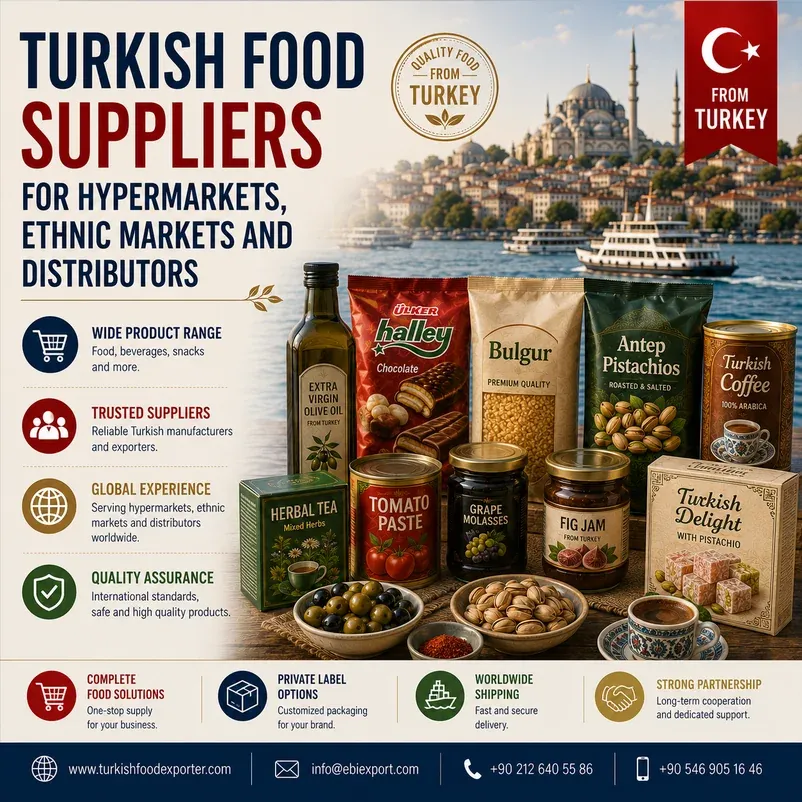
 Turkish Food Suppliers for Hypermarkets, Ethnic Markets and Distributors
International food retail is built on variety, reliability and repeat supply. Hypermarkets, ethnic markets and distributors need products that can move steadily, fit customer expectations and arrive with clear export organization. This is why many buyers look for Turkish food suppliers that can provide not only individual products, but a complete FMCG sourcing structure from Turkey.
Turkey offers a wide range of food and fast moving consumer goods for international markets. From staple foods and sauces to snacks, beverages, tea, coffee, confectionery, personal care and cleaning products, Turkish suppliers can support different retail channels with flexible product selections. Turkish Food Exporter, as an Ebi Export brand, helps buyers access these categories through an export-focused supply approach.
Hypermarkets need broad product ranges. A single product category is usually not enough. Buyers may need pasta, tomato paste, snacks, beverages, tea, coffee, desserts, household cleaning products and personal care items within the same purchasing cycle. Turkey is a practical sourcing market because it can offer this variety through established food and FMCG supply channels.
For hypermarkets, shelf performance is important. Products must be recognizable, properly packaged and suitable for repeat purchasing. Turkish food products can serve both mainstream grocery shelves and ethnic food sections. This gives retailers more flexibility when building category depth.
A hypermarket buyer may start with Turkish tomato paste, pasta and sauces, then add snacks, beverages or confectionery products according to demand. Working with an experienced Turkish food supplier makes this expansion easier because the buyer can manage multiple categories through one organized export process.
Ethnic markets usually need products that carry cultural familiarity. Turkish tea, coffee, halva, Turkish delight, jams, molasses products, sauces, pasta, spices and traditional desserts can create strong demand in stores serving Turkish, Middle Eastern, Balkan, Central Asian and Mediterranean communities.
These products are not only nostalgic items. Many of them are daily consumption products. Tea, coffee, pasta, tomato paste, snacks and beverages can become repeat-purchase items when the right product mix is selected. For ethnic market owners, this matters because steady movement is more valuable than one-time shelf decoration.
Turkish Food Exporter helps ethnic market buyers source different categories from Turkey, including Turkish delight, halva, staple foods, snacks and beverages. A balanced selection can help stores serve both loyal community demand and new customers discovering Turkish products for the first time.
Distributors need structure. They often supply many stores, supermarkets or regional retailers, so they require consistent product information, practical shipment planning and clear communication. In this type of business, a supplier must understand carton quantities, pallet structure, product availability, shelf life and export documentation.
Working with Turkish food suppliers can help distributors build a wider product catalog without contacting each manufacturer separately. This is especially useful for mixed FMCG orders. A distributor may want to combine staple foods, snacks, beverages and household goods in one shipment. When managed correctly, this saves time and reduces operational confusion.
For distributors, the best Turkish food supply plan usually starts with categories that are easy to sell and easy to repeat. Snacks, pasta, tomato paste, fruit juice, tea, coffee, confectionery and cleaning products can all be tested according to the local market. Once sales data becomes clear, the distributor can increase volume in the strongest categories.
Turkey’s food export range includes many categories suitable for hypermarkets, ethnic markets and distributors. Staple foods are one of the strongest starting points. Products such as pasta, sauces, soup mixes, spices, ready meals and tomato paste are practical because they are used regularly in households and food service channels.
Snack products are also important for retail shelves. Buyers can source Turkish chips, biscuits, crackers, wafers, cakes, chocolate, gum and candy products. These categories are useful because they are familiar to consumers and can be tested in different markets with relatively low risk.
Beverages create another strong opportunity. Bottled water, soda, soft drinks, iced tea and fruit juice products from Turkey can support both ethnic grocery shelves and broader retail distribution. For importers that already sell Turkish food products, beverages can complete the shopping basket.
In addition to food, many FMCG buyers also add personal care and cleaning categories. Shampoo, soap, cologne, detergent, softener, bleach and dishwashing products can help distributors serve more retail needs through the same sourcing channel.
Choosing the right supplier is not only about price. Price matters, of course, but in export business the cheapest offer can become expensive if the details are weak. Buyers should check whether the supplier can provide updated product lists, package details, carton information, shelf life, loading options and shipment support.
A strong supplier should also understand the buyer’s market. Hypermarkets may need branded products with shelf appeal. Ethnic markets may prioritize traditional Turkish products. Distributors may focus on product rotation, carton efficiency and wholesale pricing. The supplier should be able to respond to these different needs with practical recommendations.
Communication is another key factor. Importers and wholesalers need quick answers, clear quotations and realistic timelines. A supplier that sends a catalog and then disappears is not a supply partner; it is just a PDF with a phone number. Serious export work needs follow-up, clarity and responsibility.
Mixed product supply is one of the biggest advantages for international buyers. Instead of importing only one category, buyers can create a wider FMCG selection from Turkey. This is useful for hypermarkets that need shelf variety, ethnic markets that need cultural product depth and distributors that need a catalog suitable for different customers.
For example, one buyer may combine pasta, tomato paste, Turkish delight, tea, chips, fruit juice and shampoo products in a single sourcing plan. Another buyer may focus on snacks, beverages and cleaning products. The right mix depends on the destination market, but Turkey has enough product diversity to support different strategies.
Turkish Food Exporter helps buyers evaluate these product groups and build a supply plan according to their business model. This approach makes sourcing more organized and gives buyers room to test, improve and scale their product range over time.
Turkish Food Exporter supports hypermarkets, ethnic markets, wholesalers and distributors that want to source food and FMCG products from Turkey. With a broad product portfolio, buyers can explore staple foods, snacks, beverages, traditional products, personal care and cleaning categories through one export-oriented structure.
For companies searching for reliable Turkish food suppliers, the best path is to work with a partner that understands both product selection and export operations. A good supplier helps buyers avoid confusion, compare categories clearly and prepare orders with realistic commercial details.
Turkey has the product range. The market has the demand. What matters is bringing both sides together with a clean, professional supply process. Turkish Food Exporter helps international buyers build that connection from Turkey to their own retail and wholesale markets.